Tetouan
The White Dove of the North — Andalusian Legacy in Morocco's UNESCO Heritage Medina
About Tetouan
Welcome to Tetouan
Tetouan (Arabic: تطوان, French: Tétouan) — the White Dove of the North — is one of Morocco's most visually distinctive and historically layered cities. Its name derives from the Tamazight word meaning 'the eyes' or 'the springs', referring to the many natural water sources flowing from the Rif hills above it. Set at the foot of the Rif Mountains with the Mediterranean Sea 10 kilometres to the east, Tetouan looks down a valley toward the coast and up toward the forested ridgelines of the Rif.
The city's extraordinary character derives from two historic waves: the 1492 Andalusian refugees who substantially rebuilt the medina and brought the culture of Muslim and Jewish Granada; and the Spanish Protectorate (1912–1956) which added the Ensanche — a grid-plan Spanish colonial new town of arcaded streets and modernist architecture directly adjacent to the medina.
In 1997, the UNESCO World Heritage Committee inscribed Tetouan's medina as an outstanding example of an Hispano-Moorish urban settlement that has maintained its cultural identity intact — 'the city represents an important example of this type of town, and conserves its traditional layout and its architecture'.
Why Visit Tetouan?
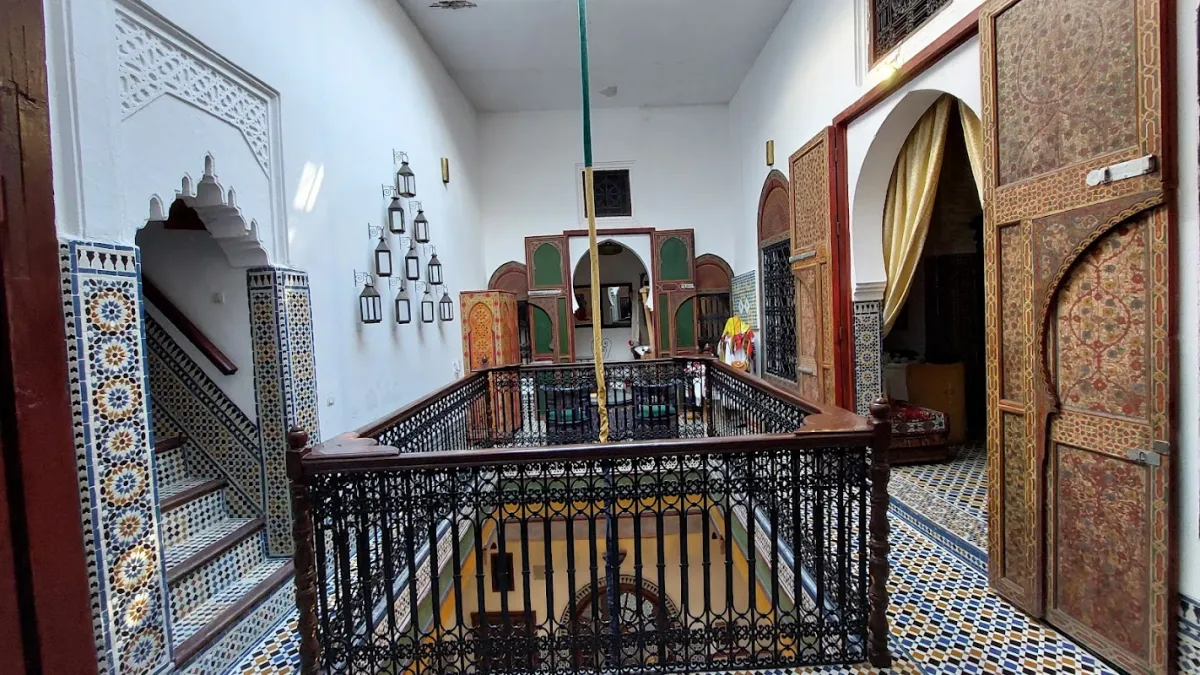
- UNESCO medina: One of the best-preserved and most authentically Andalusian medinas in Morocco — Granadan Moorish architecture, tile work, and urban planning transplanted to North Africa
- The Ensanche: The Spanish colonial new town — a grid of arcaded streets, Spanish Art Deco buildings, and European-style plazas immediately adjoining the medina — is one of North Africa's most complete colonial-era town plans
- Mellah and Jewish heritage: Tetouan had one of Morocco's significant Sephardic Jewish communities until mid-20th century migration; the mellah and its architecture survive as an important heritage layer
- Ecole des Beaux-Arts: Tetouan's School of Fine Arts — founded during the Protectorate and continuing today — is a significant centre of Moroccan visual arts and regularly holds public exhibitions
- Mediterranean beaches: Martil (10 km), Cabo Negro (12 km), and M'diq (14 km) are all within easy reach for beach days
- Jbel Dersa and Rif scenery: The wooded Rif hillsides above the city offer walking and scenery
Quick Info
Location
Morocco
Attractions
54 places to visit
Average Rating
4.4 / 5
Best Time to Visit
April - June, September - October (pleasant mountain-Mediterranean climate, before peak summer beach season; July - August busiest with domestic tourism)
Population
611,928
Region
Tanger-Tétouan-Al Hoceïma
From Ancient Tamuda to the Andalusian Refuge
Ancient Tamuda
The ancient site of Tamuda — a pre-Roman Amazigh settlement and later a Roman camp — lies a few kilometres from the current city centre along the Martil river. Archaeological excavations at Tamuda have documented significant Roman-period occupation, and the site is partially open to visitors. The current city of Tetouan (Titawin), however, was essentially founded in the medieval period.
Medieval Foundation and Portuguese Destruction
Tetouan was established as a significant city in the 13th–14th centuries under the Merinid dynasty. The Portuguese forces attacked and destroyed the city in 1437, and it was abandoned for several decades.
The Andalusian Refugees (1492 onwards)
Tetouan's defining historical moment was the arrival of Muslim and Jewish refugees expelled from the Emirate of Granada after its fall to Ferdinand and Isabella in January 1492. The Reconquista ended eight centuries of Muslim rule in Spain and produced a vast refugee population who crossed to Morocco. A significant community settled at Tetouan — partly because its valley offered conditions similar to the Andalusia they had left — and substantially rebuilt the destroyed city. They brought with them the architectural traditions, craft skills, music, culinary culture, and even the Arabic dialect of Andalusian Spain. The medina that survives today largely reflects this 15th and 16th-century Andalusian-influenced reconstruction, alongside continued development through later centuries.
The Tetouan Junta and the Rif Corridor
In the 17th century, Tetouan became a significant privateering base — like Salé on the Atlantic coast. Its location near the Strait of Gibraltar made its corsairs an important force in Mediterranean commerce raiding. The city's commercial wealth grew through the 18th and 19th centuries as a trading centre for northern Morocco.
The Spanish Protectorate (1912–1956)
The 1912 Treaty of Fes established the French Protectorate over most of Morocco, but assigned the northern zone to Spain. Tetouan became the capital of the Spanish Protectorate zone — the administrative centre for the Spanish-administered north. The Spanish built the Ensanche (the new town) directly adjacent to the medina, creating one of North Africa's most architecturally coherent colonial new towns. Spanish administration also developed the roads, schools, and infrastructure of the northern zone. At Moroccan independence in 1956, Spanish protectorate was ended and Tetouan was reintegrated into the Kingdom of Morocco. The Spanish architectural and cultural legacy remains highly visible in the city.
Things to Do in Tetouan
Explore top-rated attractions, cultural landmarks, and local activities